If you're over 50 and trying to lose fat without losing the muscle you still have, protein is the single most important dietary lever you can pull — and the odds are high you're not eating nearly enough of it. Understanding how much protein after 50 for fat loss requires understanding that the standard dietary recommendations were never designed for people actively trying to preserve muscle while aging.
Why Protein Needs Rise Dramatically After 50

The standard recommended daily allowance (RDA) for protein sits at 0.8 grams per kilogram of body weight. That number was set as a floor for basic survival — not a target for muscle preservation or fat loss — and emerging evidence makes clear it is insufficient for adults over 50.
The reason has a name: anabolic resistance. As you age, your muscles become progressively less responsive to the normal protein signals that trigger repair and growth. In younger adults, a modest amount of dietary protein reliably stimulates muscle protein synthesis. After 50, that same stimulus produces a blunted response — so the body needs a larger protein signal to generate the same outcome. It's not that protein stops working; it's that the dose required to get the job done increases.
This matters for fat loss specifically because muscle tissue is metabolically active. A 2021 NIH review confirmed that maintaining fat-free mass (muscle) during weight loss directly protects resting energy expenditure — meaning people who lose muscle alongside fat end up with a slower metabolism that makes keeping the weight off progressively harder. Protecting muscle during a caloric deficit isn't optional; it's the difference between fat loss and body composition deterioration.
The Actual Protein Targets Supported by Research
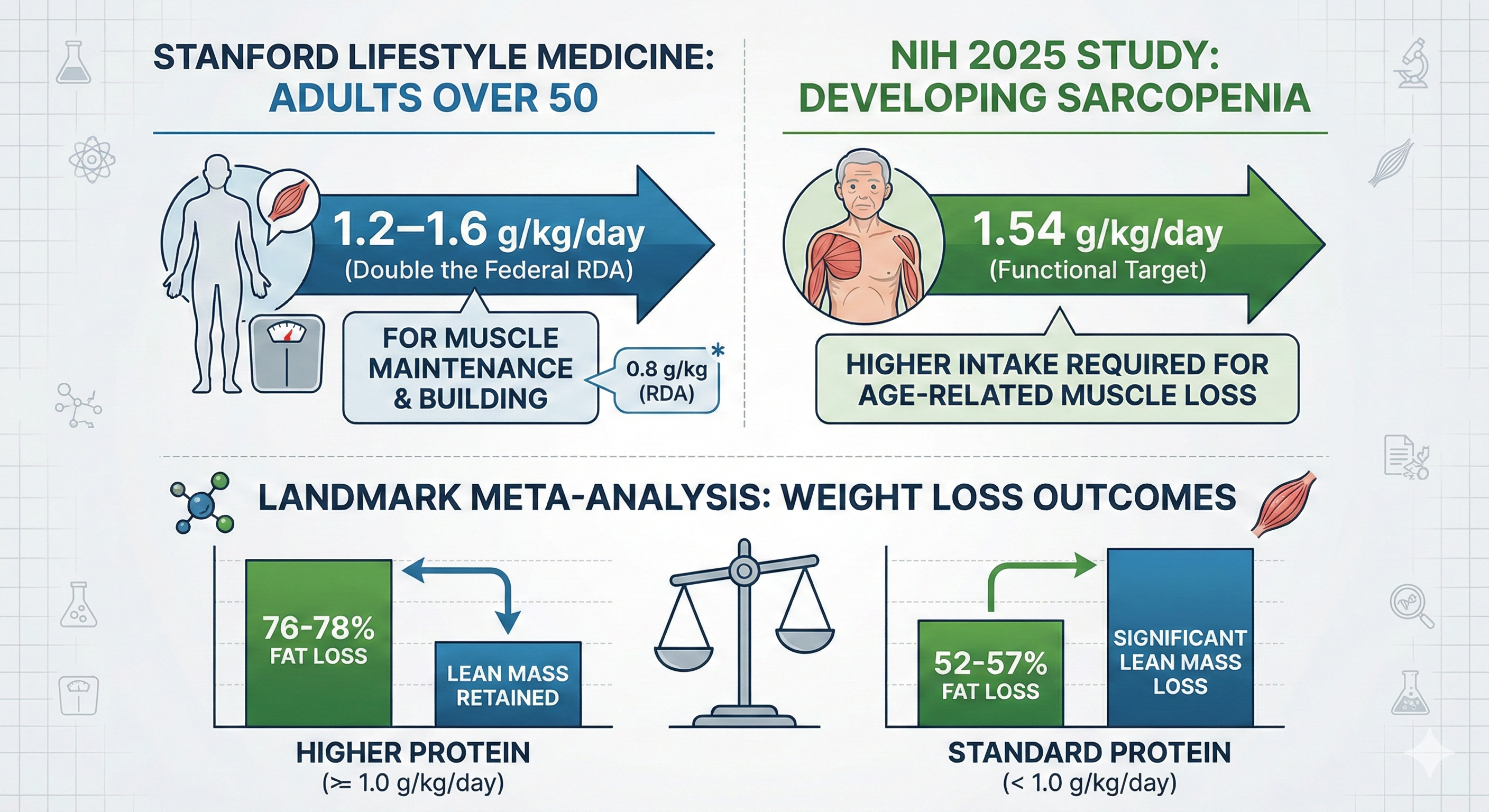
The science has converged on a clear evidence-based range for adults over 50. Stanford Lifestyle Medicine recommends 1.2–1.6 grams of protein per kilogram of body weight per day — roughly double the federal RDA — for adults over 50 who want to maintain or build muscle.
For people with already-developing sarcopenia (age-related muscle loss), a 2025 NIH study set the recommended protein intake even higher: 1.54 grams per kilogram of body weight daily as the functional target. A landmark meta-analysis found that older adults consuming protein at or above 1.0 g/kg/day during weight loss retained significantly more lean mass while losing a greater percentage of fat mass than those on normal-protein diets. In practical terms, 76–78% of the higher-protein group lost weight primarily as fat — compared to only 52–57% of the standard-protein group.
Here's what those numbers mean for real people:
| 140 lbs (64 kg) | 51g/day | 77–102g/day |
| 165 lbs (75 kg) | 60g/day | 90–120g/day |
| 190 lbs (86 kg) | 69g/day | 103–138g/day |
| 220 lbs (100 kg) | 80g/day | 120–160g/day |
What Actually Works to Hit These Targets After 50
Why Meal Distribution Matters as Much as Total Intake
Hitting a daily protein target isn't enough on its own — when you distribute that protein matters significantly after 50. Research published in NIH's journal network found that meeting a protein threshold of approximately 30–35 grams per meal — rather than concentrating most of it in one sitting — represents the most effective strategy for triggering muscle protein synthesis in middle-aged and older adults. This is because the anabolic response to protein in older adults is more sensitive to per-meal dose than total daily intake.
Stanford Lifestyle Medicine specifically recommends consuming 30–35 grams of protein within two hours of a workout to maximize the muscle-building window when the training signal and nutritional fuel align. Missing this post-workout window is one of the most commonly overlooked gaps in how people over 50 approach protein.
Why Whey Isolate Is Particularly Effective After 50
Not all protein sources trigger muscle protein synthesis equally. Whey protein carries one of the highest concentrations of leucine of any available protein source — and leucine is the specific amino acid that acts as the molecular "switch" activating muscle protein synthesis. Whey is also a fast-absorbing protein, which produces a stronger acute anabolic response compared to slower proteins like casein — making it especially effective in the post-workout window.
A peer-reviewed study found that subjects supplementing with whey protein during a caloric deficit lost significantly more body fat and preserved significantly more lean muscle than the control group — with the whey group achieving a fat-to-lean loss ratio of 3.75:1 compared to 1.05:1 in the non-supplementing group. That's not a marginal difference; it's a fundamentally different body composition outcome from the same caloric deficit.
Whey isolate specifically — rather than concentrate — is the more practical choice after 50 because it delivers a higher protein-per-serving density with minimal fat and lactose. For anyone with mild dairy sensitivity, isolate processes out most of the lactose that causes digestive issues with concentrate. A post-workout shake of 30–40 grams of high-quality whey isolate is one of the most efficient ways to hit the post-workout protein threshold and close the gap toward daily targets.
Why Strength Training Converts Protein Into Results
Protein without resistance training is like building materials without a construction crew — the raw inputs are present, but nothing gets built. Muscle protein synthesis is only significantly activated when two signals arrive simultaneously: the mechanical stimulus of resistance training and the nutritional substrate of dietary protein. Neither alone is sufficient for meaningful muscle preservation after 50.
The clinical implication is direct: resistance training 2–3 sessions per week targeting major muscle groups amplifies the body's ability to utilize dietary protein for muscle repair and growth. Compound lifts — squats, deadlifts, rows, chest and overhead presses — recruit the largest muscle groups and trigger the strongest hormonal response, which is particularly important as testosterone and growth hormone decline with age. A 6-month study of older adults found that whey protein supplementation combined with resistance training significantly improved whole-body lean mass and muscle strength — outcomes that protein or training alone produced less effectively.
For those returning to training after a long break, bodyweight movements and light compound work protect joints while still delivering the anabolic stimulus that turns dietary protein into preserved muscle. The dose doesn't need to be extreme; it needs to be consistent.
The Realistic Timeline: What 6–10 Weeks Actually Looks Like
Progress after 50 is real — it just requires slightly more patience than it did at 35.
In weeks 1–3, consistently hitting 30–35 grams per meal typically improves satiety and reduces between-meal hunger noticeably. This alone often produces modest fat loss even before training adaptations take hold, because reduced caloric intake follows naturally from better appetite regulation.
By weeks 4–6, the combination of strength training and adequate protein begins producing visible strength gains — the clearest biological signal that muscle tissue is being built or preserved rather than lost. Waist circumference often begins to respond before the scale does, because lean mass is replacing some fat mass.
By weeks 8–10, a meaningful body composition shift becomes apparent in both measurements and how clothing fits. A 2021 NIH review noted that maintaining fat-free mass over a 13–20 week intervention required both elevated protein intake and an exercise program — and those who combined both showed substantially better outcomes than either strategy alone.
A Standard Worth Keeping
The framework is straightforward: target 1.2–1.6 grams of protein per kilogram of body weight daily, distribute it across meals in 30–35 gram doses, prioritize a high-quality whey isolate shake within two hours of resistance training, and lift compound movements 2–3 times per week. Together, these inputs create the metabolic and structural environment that makes fat loss sustainable — not by eating less and losing muscle, but by eating more strategically and keeping it.
What's your biggest challenge right now — figuring out how to hit your protein targets through food, finding the right supplement, or building the workout habit? Leave a comment below — your answer shapes what I cover next.
Subscribe for weekly updates on evidence-based nutrition and training strategies for people over 50.


